What Kind of Trip Each Country Gives You
A Thai honeymoon usually has a slow rhythm. Many couples land in Bangkok, spend a few nights at a jungle camp in the north, then fly south for a long beach finale in Phuket, Krabi or Koh Samui. The days are spa, boat trip, sunset bar, dinner.
A Vietnamese honeymoon moves more. Hanoi gives you lakes, colonial boulevards and street food. Ha Long Bay or quieter Lan Ha Bay gives you a night on a boat among roughly 1,600 limestone islands. Hoi An is the romantic heart of most itineraries, with tailors, lanterns and beach resorts nearby. Phu Quoc or Con Dao gives you the beach at the end.
If the two of you get restless after three days on a sun lounger, Vietnam keeps things interesting. If the whole point is to switch off after the wedding, Thailand makes that easier.
Weather and Timing
Thailand's advantage is its two coasts. The Andaman side, with Phuket and Krabi, is best from about November to April. The Gulf side, with Koh Samui, is driest from January to April and often pleasant through summer, with its heaviest rain from October to December. The north is loveliest in the cool, dry months from November to February.
Vietnam has three climates that never align perfectly. The north is gray and cool in winter and best from March to April and late September to November. Hoi An and the center are best from February to May, with flood season from mid-October through November. The south and Phu Quoc are dry from November to April.
The sweet spot for a full Vietnam trip is late February through April. For Thailand it is November to February, or Samui in summer.
Beaches and Islands
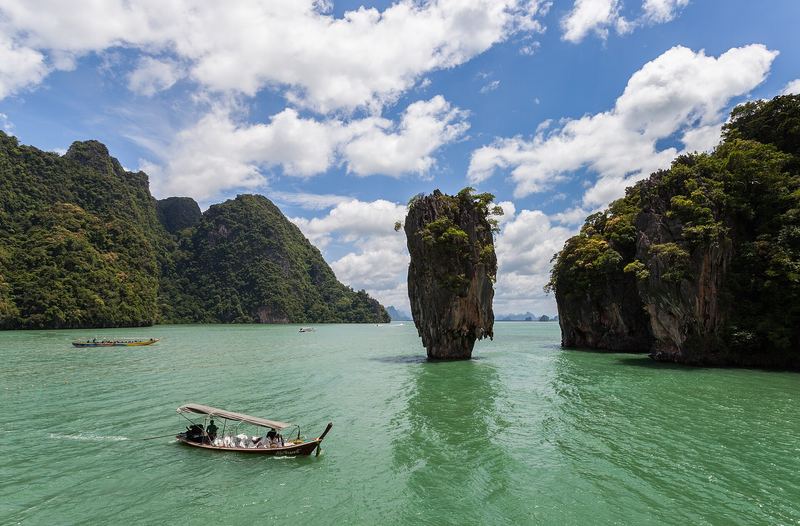
Thailand wins on beaches. It is not especially close. Phang Nga Bay's limestone towers, the boat-only coves of Railay, the calm bays of Samui and quieter islands such as Koh Lanta give you a huge range of settings. Boat days to the Phi Phi Islands, the Similans or Ang Thong National Marine Park are some of the best in Asia.
Vietnam's beaches are good rather than famous. Phu Quoc has the widest choice of beach hotels, with sunsets over the Gulf of Thailand and boat days around the An Thoi islands. Con Dao is the quiet alternative, a national park island with nesting sea turtles in season.
Vietnam's great water experience is not a beach at all. It is waking up on a cruise among the karsts of Ha Long or Lan Ha Bay, kayaking into lagoons before breakfast.
Hotels and Splurges
Thailand's luxury hotel scene is one of the most sophisticated in Asia. The Michelin Guide awards its hotel Keys to a number of Thai properties. Our favorites include Trisara on Phuket's northwest coast, Keemala's tree house villas above Kamala, Rayavadee on Railay, Six Senses Samui and Four Seasons Tented Camp Golden Triangle, with 15 all-inclusive tents reached by river boat.
Vietnam has fewer famous names but some excellent ones. Four Seasons Resort The Nam Hai near Hoi An and Six Senses Con Dao are the classic splurges. A beautiful boutique hotel in Hanoi's Old Quarter or a riverside villa in Hoi An costs far less than its equivalent elsewhere.
For couples who want to stay in two or three outstanding resorts, Thailand gives more choice. For couples who want one big splurge surrounded by charming, affordable boutique stays, Vietnam is hard to beat.
How Far Your Money Goes
Both are strong value next to the Maldives or French Polynesia. In Thailand, our rough high-season guide is $300 to $700 a night for upscale pool-villa resorts and $700 to $1,500 for top-tier luxury, with the most exclusive villas and jungle camps often above that. Massages, street food and rides cost a fraction of US prices, while imported wine is heavily taxed.
Vietnam stretches further. A comfortable mid-range trip with boutique hotels, a mid-level bay cruise and domestic flights runs roughly $200 to $350 a day for two before international flights. Luxury starts around $600 a day and can pass $1,500 at the most exclusive villas. A very good dinner for two with drinks is often $40 to $80. Domestic flights frequently cost under $100.
All figures are approximate and change with season and exchange rates.
Flights and Getting Around
Vietnam has one real edge here: Vietnam Airlines flies nonstop between San Francisco and Ho Chi Minh City, about 16 hours outbound. Every other routing to either country connects, usually through Tokyo, Seoul, Taipei, Hong Kong, Singapore or a Middle East hub, with 18 to 24 hours of total travel from most US cities. For Thailand, plan on landing in Bangkok (BKK) or Phuket (HKT).
Inside the country, both rely on short domestic flights. Thailand's routes from Bangkok to Chiang Rai, Phuket, Krabi and Samui take about an hour to an hour and a half. In Vietnam, flights link Hanoi, Da Nang, Ho Chi Minh City, Phu Quoc and Con Dao in one to two hours. Book an open-jaw ticket into Hanoi and out of Ho Chi Minh City to avoid backtracking.
In both, use Grab or hotel cars rather than unmetered taxis and skip the scooter. In Vietnam riding one without a local license is illegal for most visitors.
Food, Culture and Etiquette
Food is a tie, which is a compliment to both. Thailand has fiery southern curries, Phuket's moo hong, night-market snacking and Michelin-recognized tasting menus. Vietnam has pho at a plastic table in Hanoi, cao lau noodles in Hoi An and grilled seafood on Phu Quoc with the island's own pepper and fish sauce, all cheap enough to eat four times a day.
Culturally, Thailand is shaped by Buddhism and deep respect for the monarchy. At temples both partners should cover shoulders and knees and remove shoes. Vietnam is relaxed but has its own customs: modest dress at pagodas, strict rules at the Ho Chi Minh Mausoleum and friendly bargaining at markets.
In both countries, keep public affection modest outside resorts. Dengue is present in each, so use repellent at dawn and dusk. If you're pregnant or hoping to be soon, check CDC travel health notices.
Making the Call
Start with your travel month. From November to February, Thailand is at its best on the Andaman coast and in the north, while northern Vietnam is cool and gray. From late February to April, both work well. Vietnam's full north-to-south route becomes realistic. In June to August, Thailand's Koh Samui is the safer beach, though central Vietnam's beaches near Hoi An are also in season.
Then think about pace. Ten to fourteen nights in Thailand can mean three stops with plenty of pool time. Ten days in Vietnam usually means four stops and more transfers, so it suits couples who enjoy the travel itself.
Couples for whom the beach is the main event should pick Thailand. Couples for whom it is the dessert after a feast of cities and bays should pick Vietnam.