Two Very Different Trips
A Thailand honeymoon is a decompression. You might start with a river cruise and rooftop dinner in Bangkok, spend a few nights at a jungle camp near the Golden Triangle and then fly south for a week of beach and pool. Distances are short, English is widely spoken in tourist areas and most days need almost no planning.
An India honeymoon is a journey. The classic route runs Delhi, Agra, Jaipur and Udaipur, with long drives or train rides between them and a lot to see in each. The rewards are huge: dinner on a rooftop facing a lit fort, a boat across Lake Pichola to a marble palace and a tiger crossing a dirt track at dawn. The trade-off is noise, crowds and long travel days.
If you both crave rest, Thailand. If you both crave discovery and have energy to spare after the wedding, India. A few couples do both and use Thailand as the reward.
Palace Hotels or Pool Villas
India's best stays are palaces. Taj Lake Palace covers its own island in Lake Pichola and you arrive by boat. The Oberoi Udaivilas faces the City Palace across the water from about 30 acres of gardens and domes, with The Leela Palace Udaipur next door. Rambagh Palace in Jaipur was the Maharaja of Jaipur's home. In Kerala, Kumarakom Lake Resort has timber villas on Vembanad Lake. Taj Exotica on Swaraj Dweep in the Andamans is a short walk from Radhanagar Beach.
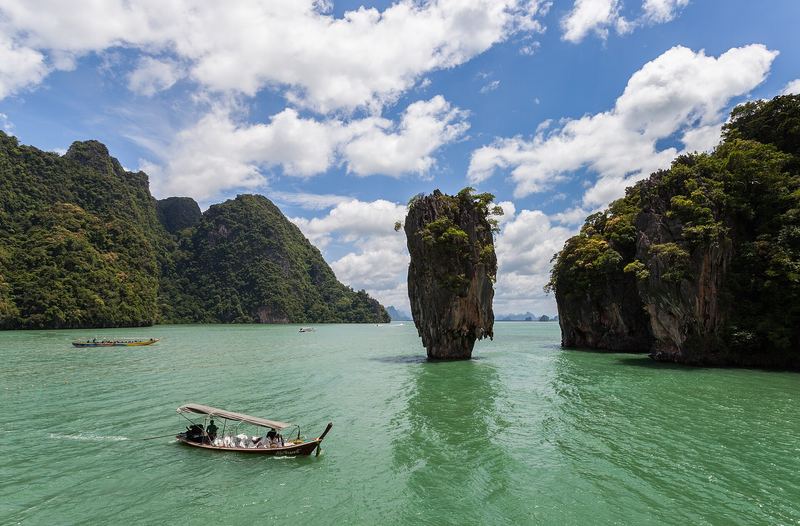
Thailand's best stays are pool villas. Trisara faces the sunset on Phuket's quiet northwest coast. Keemala scatters tree houses and bird's nest villas through rainforest. Rayavadee in Railay is reachable only by boat. Six Senses Yao Noi gives every villa an infinity pool over Phang Nga Bay and Six Senses Samui sits on a breezy Gulf headland. Four Seasons Tented Camp Golden Triangle has just 15 tents in bamboo jungle.
When Each Country Shines
The calendars overlap neatly in winter. India's main season runs from October to March, when Rajasthan and Agra are dry and sunny and Goa, Kerala and the Andamans have calm seas from November. Thailand's Andaman coast, home to Phuket and Krabi, is best from November to April, with December to February driest. Northern Thailand is loveliest from November to February.
They diverge in summer. India gets very hot from April to June, with northern temperatures passing 100°F. The monsoon then brings heavy rain from June to about September. Thailand's Andaman side is rainy from May to October too, but the Gulf of Thailand around Koh Samui is often pleasant through June, July and August.
So a winter wedding gives you a free choice. A summer wedding points to Koh Samui. India in summer works only for monsoon lovers or for tiger spotting in the heat of April to June.
Flights and Getting Around
India has the shorter journey for East Coast couples. Air India and United fly nonstop from the New York area to Delhi in roughly 14 to 16 hours, with United also serving Mumbai from Newark. From the West Coast, one-stop routings through the Gulf or Europe often work better.
Thailand generally has no nonstop US flights. Most couples connect in Asia or the Middle East to Bangkok (BKK) or straight to Phuket (HKT), with 20 hours or more of total travel.
On the ground, Thailand is easier. Domestic flights, ferries and Grab cars link everything with little fuss. India's domestic airlines connect every major destination, but road journeys are long and chaotic, so most couples hire a car and driver for the Rajasthan circuit. Fast daytime trains between Delhi, Agra and Jaipur are a pleasant way to cover those legs. Allow extra time around Delhi in December and January, when fog can delay trains and flights.
Money Matters
Both are very good value, with hotels that cost a fraction of their European equivalents. In India, heritage hotels and boutique havelis in Rajasthan often run about $100 to $250 a night, while the famous palace hotels commonly start around $500 to $1,000 in peak months. A private car and driver is one of India's best bargains.
In Thailand, upscale pool-villa resorts run roughly $300 to $700 a night in high season and top-tier resorts about $700 to $1,500. Green season rates can drop by a third or more. Massages and street food cost a fraction of US prices, while imported wine is heavily taxed.
The big difference is how you spend. In India, the money goes to palace hotels, guides and drivers on a moving trip. In Thailand, it goes to one or two long resort stays. All prices are approximate and vary with season and exchange rates.
Safety, Dress and Comfort
The State Department rates India Level 2, citing crime and terrorism, with separate Level 4 warnings for regions such as Jammu and Kashmir and Manipur. None of the classic honeymoon areas are in those zones. Scams and pickpocketing are common in busy markets and women may get unwanted attention, so use hotel cars or app taxis after dark.
Thailand is generally easygoing for couples. Rip currents and rough seas come with the Andaman monsoon from May to October, so swim where flags allow. Respect the monarchy, which is protected by law.
Both countries are conservative at religious sites. Cover shoulders and knees for both of you at temples, mosques and gurdwaras and remove shoes where others do. Keep affection modest in public. Dengue is present in both, so use repellent at dawn and dusk. If you're pregnant or hoping to be soon, check CDC travel health notices.
The Best of Both
Bangkok is a short flight from Delhi, Mumbai and Kolkata, so a combined honeymoon is very doable with two and a half to three weeks. Spend about ten days on India's classic route of Delhi, Agra, Jaipur and Udaipur, then fly to Bangkok for a night before a week on Phuket, Krabi or Koh Yao Noi. Rajasthan's culture and crowds followed by Thailand's beaches is a satisfying arc.
With two weeks or less, choose one. A focused India trip can still include beach time, since Kerala's backwaters, Goa and the Andaman Islands give you rest at the end. Goa suits couples who want seafood and a social scene, while the Andamans have clear water and diving off Swaraj Dweep. A focused Thailand trip can still include culture, with temples in Bangkok and Chiang Mai, elephants in the north and a cooking class on the islands.