Scenery Side by Side
Both are among Thailand's most dramatic landscapes, built from the same limestone. On Phi Phi, sheer walls drop into water that shifts from turquoise to deep blue. Phi Phi Leh's Pileh Lagoon is a cliff-walled pool of green water. The climb to the viewpoints above Tonsai gives the classic picture of two curved bays. Maya Bay, made famous by the film The Beach, now has rules: boats drop visitors at the back of the island, time on the sand is limited and swimming is not allowed.
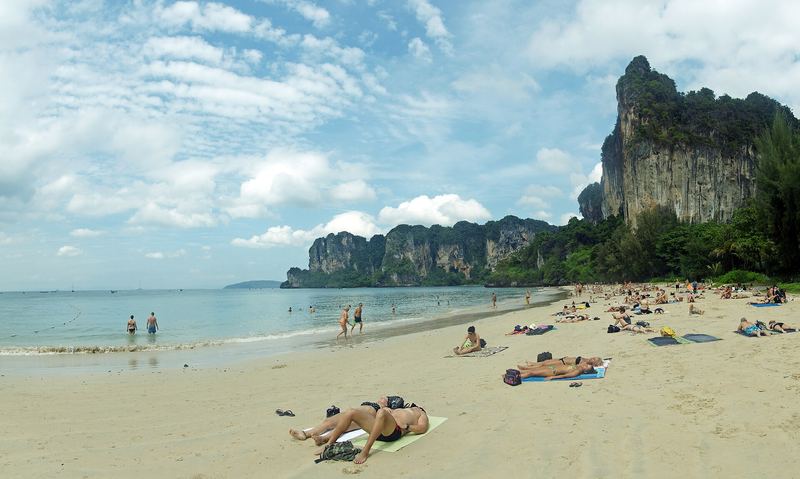
On Railay, the beaches themselves are framed by cliffs. Phra Nang Beach is a crescent of soft sand beneath towering rock, with a cave shrine to a legendary sea princess. Climbers hang off the walls in the afternoon. At sunset the cliffs glow gold, then pink, then violet.
Phi Phi's beauty is something you visit by boat. Railay's is right outside your room.
Quiet Evenings and Party Nights
This is the biggest honeymoon difference. Phi Phi works on one condition: do not stay in Tonsai. The village and adjoining Loh Dalum Bay are the center of the party scene, with bass music into the early hours. They also fill with day-trippers from mid-morning. Long Beach, south of Tonsai, is a calmer middle ground. The honeymoon resorts are in the north and east, at Laem Tong and Loh Bagao, reached by your resort's boat and quiet in the evening.
Railay is calmer by nature. There are no cars. Once the day-trippers leave, evenings have a hushed, almost village feel. Beach restaurants and laid-back bars line the walkways between beaches. Ton Sai, next door, draws climbers and backpackers. If you want a night out, Ao Nang is a short longtail ride away.
In short, Railay is quiet almost everywhere. Phi Phi is quiet only if you choose your beach carefully.
Resorts Worth Booking
Railay's top address is Rayavadee, about 100 two-story pavilions and villas among coconut groves at the tip of the peninsula. It is the only place where your room sits between three beaches: Railay West, quieter Nam Mao and Phranang. Pool Pavilions have private pools in walled gardens, while The Grotto serves dinner inside a limestone cave on Phranang Beach. It is our top pick for honeymooners in the area. Mid-range resorts line Railay West and East. On the mainland, the coast around Klong Muang and Tubkaek has larger luxury resorts on quieter beaches.
On Phi Phi, Zeavola at Laem Tong is a long-established favorite, with teak suites set back from a soft sand beach. Loh Bagao on the east coast has larger resorts with villas and pools. Expect higher rates than in the village. Ask exactly how boat transfers work before you book.
As a rough Thailand guide, upscale pool-villa resorts often run about $300 to $700 a night in high season. Prices are approximate.
On and Under the Water
Phi Phi has the edge for snorkeling, which is some of the most accessible in Thailand. Charter a private longtail early and head to Phi Phi Leh before the tour boats, then swim in Pileh Lagoon, drift past Viking Cave and stop at Bamboo Island for white sand and coral. Shark Point is known for blacktip reef sharks, on a snorkel trip or a beginner dive.
Krabi is better for doing things together. Kayak through mangrove channels and along cliff bases to hidden caves. Try a guided half-day climb on Railay's famous limestone, where instructors choose easy routes with long views. Hire a private boat to the Hong Islands, where a lagoon sits inside a ring of rock. Phi Phi itself is a day trip from Railay, though staying overnight beats arriving in the midday rush.
On both, use reef-safe sunscreen and a rash guard for long snorkel sessions.
Getting There and Getting Around
Both start the same way. There are no nonstop flights from the US to Thailand, so most couples connect through Bangkok or another Asian or Middle Eastern hub to Krabi International Airport (KBV). Phuket International Airport (HKT) is another option.
For Railay, drive to the coast and take a boat. Longtails run from Ao Nang to Railay West in about 15 minutes. Rayavadee arranges private car-and-speedboat transfers. Expect to wade through shallow water, so pack soft luggage.
For Phi Phi, add about 30 minutes to the pier and a ferry of roughly 1.5 to 2 hours, or about 2 hours from Phuket. All public boats land at Tonsai, so arrange pickup if your resort is in the north. There are no cars on Phi Phi Don either. Paths link Tonsai with Long Beach, but most travel is by longtail. Agree on prices before boarding and keep cash for small pier and park fees.
Timing Your Trip
Season is not a deciding factor here, since both sit on the Andaman coast. The best months are November to April, when the northeast monsoon brings dry weather and calm seas. December to March is the sweet spot for clear water and smooth boat rides. It is also when prices peak, especially over the holidays and Chinese New Year. March and April are hotter but often quieter.
From about May to October, the southwest monsoon arrives. Rain usually comes in heavy bursts and the landscape turns lush, but seas can cancel boat trips. That hits Phi Phi harder, since you depend on ferries to come and go. Maya Bay may also close during the low season. Railay still needs a boat, but the ride from Ao Nang is short.
If you must travel in June to August, consider the Gulf islands instead. If you're pregnant or hoping to be soon, check CDC travel health notices for Thailand, since dengue occurs on this coast.
The Best Way to Do Both
Ferries link Railay and Phi Phi in high season, so an Andaman honeymoon can include both without backtracking. A balanced plan is three or four nights on Railay, then two or three nights at a quiet northern beach on Phi Phi, then on to Koh Lanta or Koh Yao Noi for a slower finish.
If you can only choose one, Krabi and Railay are the safer honeymoon pick for most couples, as our Phi Phi guide also suggests. Visit Phi Phi on a private boat day. Choose Phi Phi as your only stop if snorkeling is the main event and you are happy to book a resort well away from Tonsai.