Two Kinds of Vineyard Hills
At a glance the landscapes look alike, but they feel different. In the Langhe, vineyards ripple across almost every slope in neat rows, broken by hazelnut orchards and woods, with castles and bell towers on the ridgetops. Morning fog lifting off the vines is one of the region's great sights. It is gentle, green and quietly working countryside.
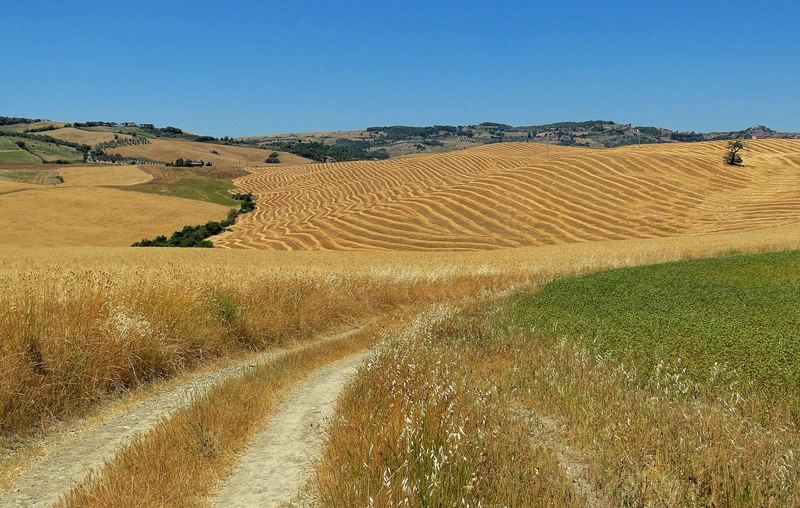
Tuscany is more varied. Chianti has wooded hills and stone villages. The Val d'Orcia in the south is the postcard: lone cypress groves, bare rolling hills and hilltop towns such as Pienza and Montalcino. There are hot springs at Bagno Vignoni and Saturnia, a coast to the west and two of Italy's most beautiful cities.
If you want one focused landscape to sink into for a week, the Langhe delivers that. If you want to change scenery every day, Tuscany gives you more to work with.
The Wine Itself
Both regions make world-class reds from a single star grape. The Langhe's is Nebbiolo, which becomes Barolo and Barbaresco: pale in the glass, firm, perfumed and long-lived. Everyday Dolcetto and Barbera fill the gaps. Arneis from nearby Roero is the local white. The wine culture is personal. Small producers in Monforte d'Alba, Serralunga and Castiglione Falletto welcome visitors by appointment. The person pouring is often family.
Tuscany's grape is Sangiovese, made into lively Chianti Classico, powerful Brunello di Montalcino and the in-between Vino Nobile di Montepulciano. Vernaccia di San Gimignano is the classic white. Dinner often ends with cantucci dipped in Vin Santo. Famous Tuscan estates can feel more polished and commercial, though family cellars around Montalcino still offer intimate tastings.
In both regions, book tastings ahead and hire a driver for heavy tasting days. Italy's drink-driving limits are strict.
Truffles, Pasta and Long Dinners
The Langhe is arguably Italy's richest food region for its size. Tajarin, a fine egg pasta with butter and sage, agnolotti del plin, vitello tonnato and hand-chopped carne cruda are standard, along with beef braised in Barolo in cooler months. Alba's Piazza Duomo, under chef Enrico Crippa, holds three Michelin stars, while village osterie serve excellent food at modest prices. In autumn, white truffles are shaved over simple dishes by the gram. Agree the weight and price before the shaving starts.
Tuscan cooking is rustic and generous. Bistecca alla fiorentina is grilled over wood and served rare. Hand-rolled pici comes with garlicky tomato or ragù. Pappardelle arrives with wild boar. Ribollita is the hearty bread and vegetable soup. Pecorino from Pienza and new-season olive oil are must-tastes. The San Miniato area has its own white truffle season in October and November.
Couples who plan days around restaurants tend to prefer the Langhe. Couples who want food as one pleasure among many do well in Tuscany.
Places to Stay
Both regions excel at small country stays rather than big resorts. In the Langhe, think restored farmhouses, agriturismi on working wine estates and boutique hotels in old palazzi, many with pools facing the vines. Casa di Langa, near Cerretto Langhe on a 42-hectare estate, gives every one of its 39 rooms a private terrace over the hills and has a heated infinity pool looking toward the castle of Serralunga d'Alba. Il Boscareto Resort near Serralunga adds a full spa.
Tuscany has a deeper bench of villas, castles and estates. Borgo Santo Pietro, a medieval villa near Chiusdino on a roughly 300-acre organic farm, has only 22 rooms and suites, some with private pools, plus the Michelin-starred Saporium and a spa using estate-grown botanicals. Florence adds grand city hotels for an art interlude.
A common Tuscan plan is two or three nights in Florence followed by four or more in the countryside. In the Langhe, one base for the whole stay works well because distances are short.
Getting There and Driving
For the Langhe, most US travelers fly into Milan Malpensa (MXP), which has nonstops from several US cities, then drive about two hours to Alba. Turin Airport (TRN), reached by connecting flights through Europe, is closer at about an hour and 15 minutes. Trains reach Alba from Turin, but service in the hills is thin, so a car is close to essential. Distances between villages are short and roads well kept.
For Tuscany, many couples fly into Rome and take the high-speed train to Florence in about an hour and a half. Florence (FLR) and Pisa (PSA) airports work with a European connection. Trains link Florence, Pisa and Siena, but hill towns and wineries need a car or a driver. Watch for ZTL zones, the camera-enforced limited-traffic areas in historic centers, which can lead to fines arriving months later. Park outside the walls and walk in.
In both, guided tours or a hired driver solve the question of who drives home from the tasting.
Timing Your Trip
September and October are the headline months in the Langhe. The harvest fills the hills with activity, the vines turn gold and russet and the white truffle season begins, with the Alba International White Truffle Fair on autumn weekends into early December. Book hotels and top restaurants well ahead. May and June are calmer and green. November brings fog, fireplaces and the best truffles, while July and August can be hot and some family wineries pause in mid-August.
Tuscany shines from May through mid-October. Late spring brings poppies and evenings outdoors. Autumn brings harvest festivals and golden light. Late autumn adds olive oil pressing. July and August are hot and Florence and Siena get crowded, though a countryside pool makes summer pleasant. Many country hotels in both regions close for part of the winter.
If autumn is your window, the Langhe has the edge. For a late spring honeymoon, both are lovely.
Pairing Them or Adding the Coast
You can do both in one trip. Alba to Florence is roughly four hours by car, or you can drive to Turin and take a fast train. Ten nights split as four in the Langhe and six in Tuscany, including two in Florence, makes a satisfying wine-focused honeymoon, though it is a lot of rich food.
Most couples, though, pair each region with water. The Langhe fits neatly with the Ligurian coast, Portofino or the Cinque Terre, or with Lake Maggiore or Lake Como, all within about two hours. Tuscany pairs naturally with Rome, Venice or the Amalfi Coast for a two-part trip of countryside then sea.
If one of you is less excited about wine, Tuscany's variety of cities, springs and Vespa rides keeps both of you busy. The Langhe still offers vineyard hiking, cycling, a sunrise hot-air balloon and the bright Cappella del Barolo near La Morra.