Fame Versus Breathing Room
Tuscany's sights are some of the most celebrated in Europe. Michelangelo's David, the Ponte Vecchio and the view from Piazzale Michelangelo at dusk are all in Florence. Siena's Piazza del Campo is one of the loveliest squares anywhere. San Gimignano's towers rise above vineyards. The price of all that is company. Florence and Siena are crowded much of the year. San Gimignano fills with tour buses by mid-morning. Go early or late and stay in the countryside.
Umbria has fewer headline sights, but they are very fine. Assisi's Basilica of San Francesco, with its Giotto frescoes, is a UNESCO World Heritage Site. Orvieto's striped cathedral holds the Signorelli chapel. Spello is all flower-filled alleys. Because many visitors arrive on day trips from Rome or Florence, the towns empty in the evening, which is when they are at their best.
For first-time visitors to Italy who want to see the greats, Tuscany is hard to skip. For couples who have been before or dislike crowds, Umbria is a relief.
Landscapes and Bases
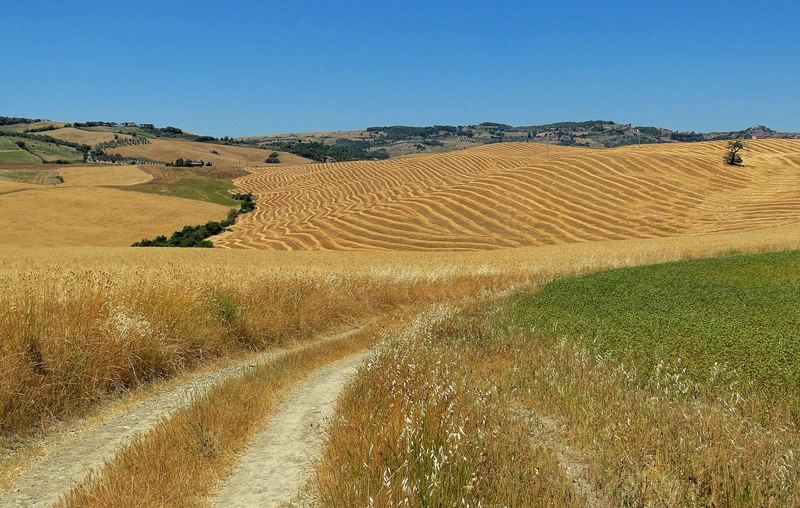
The Tuscan countryside is the one you have seen in photographs. The Val d'Orcia has rolling hills, lone cypress groves and hilltop towns like Pienza and Montalcino. Chianti, between Florence and Siena, is greener and more wooded, with vineyards and castles. Most couples split the trip: two or three nights in Florence for art and dinners, then four or more at a villa, wine estate or agriturismo in Chianti or southern Tuscany.
Umbria's landscape is similar but more wooded and less manicured. The area between Assisi, Spello and Montefalco makes a good central base, with several towns and wineries within half an hour. Around Orvieto, you are closer to Rome. The hills near Lake Trasimeno blend into Tuscany. Further east, the Piano Grande near Norcia bursts into color with lentil and wildflower blooms in early summer.
In both regions, stay in the countryside and drive into the towns. Pick a base with a pool for the hot afternoons.
Country Estates and Prices
Tuscany has some of Italy's most celebrated country hotels. Borgo Santo Pietro, a medieval villa near Chiusdino on about 300 acres of organic farmland, has just 22 rooms and suites, some with private pools, a Michelin-starred restaurant built around its own harvest and a spa using estate botanicals. Florence also has excellent luxury hotels for a city interlude. Below the top tier, family-run agriturismi in Chianti and the Val d'Orcia offer warm hosts and big breakfasts.
Umbria's range is similar, but prices for villas and farm stays tend to run lower than in comparable parts of Tuscany. Castello di Reschio, a restored castle estate near the Tuscan border, is the region's best-known splurge, from roughly $1,000 a night in shoulder season. Most couples choose a restored farmhouse or villa with a pool, gardens and views, then drive to dinner.
All prices are approximate. For the same budget, Umbria often buys a larger property with more privacy, while Tuscany buys the famous address.
Wine and the Table
Tuscany is one of the great wine regions of the world. Chianti Classico is lively and food-friendly. Brunello di Montalcino is powerful and age-worthy. Vino Nobile di Montepulciano sits between them. Vernaccia di San Gimignano is the white. Book tastings at well-known estates ahead. At the table, order bistecca alla fiorentina served rare, hand-rolled pici, pappardelle with wild boar and ribollita. Finish by dipping cantucci into Vin Santo.
Umbria's food is earthier. Strangozzi or umbricelli pasta comes with black truffle. Castelluccio lentils, porchetta and Norcia's cured meats are local pride. Olive oil from the hills around Trevi and Spoleto is excellent. The signature wine is Sagrantino di Montefalco, a powerful red, with lighter Montefalco Rosso and white Orvieto Classico and Grechetto for lunch. Perugia is home to Baci chocolates.
Tuscany offers more famous labels. Umbria offers bolder rustic flavors and tastings where you are often the only guests. On wine days in either, hire a driver so you both can enjoy every glass.
Getting There and Driving
Many US travelers reach Tuscany by flying into Rome and taking the high-speed train to Florence, roughly an hour and a half. Florence (FLR) and Pisa (PSA) are handy if you connect through a European hub. The countryside is usually an hour to an hour and a half by car from either.
Umbria is closer to Rome. Fly into Rome Fiumicino (FCO), which has nonstops from many US cities, then rent a car. Orvieto is about 1 hour 45 minutes away and Assisi a little over two hours. Perugia's small airport (PEG) has limited European flights. Trains link Orvieto, Perugia, Assisi and Spello, so a town-to-town trip without a car is possible.
For countryside stays in either region, rent a car or hire a driver. Both have ZTL limited-traffic zones in historic centers, enforced by cameras, with fines that can arrive months later. Park outside the walls and walk in. Orvieto and Perugia have escalators or funiculars up from the parking lots.
Best Seasons for Each
Both regions shine from May to June and September to October. Spring brings green hills and poppies along the roads. Autumn brings the grape harvest, olive picking and golden light.
Each has seasonal events worth timing a trip around. In Tuscany, white truffle season around San Miniato starts in October and November. In Umbria, Spello's Infiorata carpets the streets with flower petal designs on the Corpus Domini weekend in late spring. Perugia holds a big chocolate festival in autumn. Many towns hold food festivals during the harvest.
July and August are hot in both. Florence and Siena are especially crowded, though countryside hotels with pools stay pleasant. Umbria's hilltop towns catch evening breezes. Winter is quiet and cold in both, with some country hotels closed. Umbria's towns stay open and truffle dishes are at their best.
Pack layers in any season, since evenings in the hills can be cool. Cover shoulders and knees for churches, including the basilica in Assisi.
One Region or Both
These two pair naturally because they share a border. A ten-night plan might be two nights in Florence, four in the Val d'Orcia or Chianti, then four in Umbria around Montefalco or Orvieto before returning the car in Rome. Lake Trasimeno sits right on the boundary for an easy transition.
With only a week, pick one. Tuscany suits couples who want Florence in the mix. Umbria suits couples landing in Rome who want to be in the countryside within two hours.
Both also combine well with the coast. Tuscany links easily with Venice, Lake Como or the Amalfi Coast. Umbria pairs well with Rome at the start or the Amalfi Coast at the end. Parts of eastern Umbria, including Norcia, are still recovering from the 2016 earthquakes, so check what is open if you plan to go that far.