Mountains and Monasteries, or Lagoons and Reefs
Bhutan's landscape is almost entirely forest and farmland, folded into steep valleys under the Himalaya. Tiger's Nest monastery clings to a cliff hundreds of feet above the Paro valley. Punakha Dzong sits where two rivers meet, framed by jacaranda trees in spring. Archers compete in village fields and most people still wear the national dress. Traffic is light and villages are spotless.
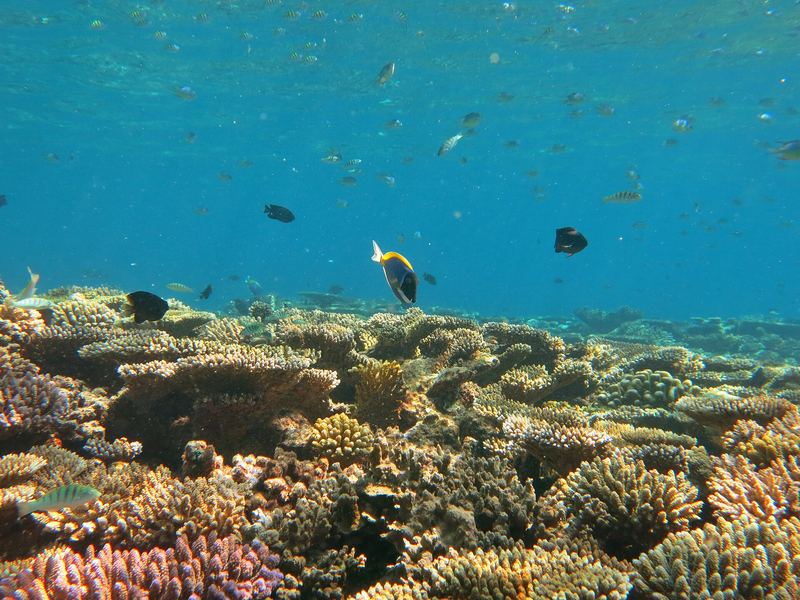
The Maldives is flat, bright and blue. Islands rise barely above the sea and the lagoons glow in shades of turquoise that look unreal in photos. The real scenery is underwater: house reefs full of turtles, reef sharks and rays, manta gatherings in Baa Atoll and whale sharks in South Ari year-round.
In Bhutan you look up. In the Maldives you look down through a snorkel mask. Both are deeply calm places, but one is calm because of its spiritual life and the other because there is simply nobody else on your island.
The Journey Each Way
Neither has nonstop flights from the US. Both take planning.
For Bhutan, fly to a regional hub such as Bangkok, Delhi, Kathmandu or Singapore, often with an overnight stop. Then take Drukair or Bhutan Airlines to Paro (PBH), the only international airport. The approach between steep ridges is flown only by specially certified pilots and the views are spectacular. Inside Bhutan you travel by road with a driver. Short distances take hours on winding roads.
For the Maldives, most couples connect through Doha, Dubai or Istanbul and land at Velana International Airport (MLE) near Malé, usually 20 hours or more from the US. Resort staff meet you at arrivals. Nearby resorts are a speedboat ride away. Remote atolls mean a seaplane, which flies only in daylight and has strict baggage limits.
Bhutan almost always requires a local operator to arrange guide, driver and itinerary. The Maldives needs only a resort booking and a transfer.
When Each One Shines
Bhutan's classic months are October and November, when skies are clear after the monsoon and mountain views are at their best. March through May is the second window, with rhododendrons and magnolias blooming and the Paro Tshechu festival usually held in spring. June through August is monsoon season, with afternoon rain and landslide risk on roads. Winter is cold and dry, with freezing nights in Paro and milder days in Punakha.
The Maldives is warm year-round. December to April is the dry season, with calm seas, great visibility and the highest rates. May and October to November are shoulder months with sun and showers. June to September is wetter and windier but cheaper. It also coincides with manta season at Hanifaru Bay, roughly May to November.
For a combined trip, two windows work well. Late March into April gives you spring in Bhutan and dry weather in the Maldives. November gives you Bhutan's peak with Maldives shoulder pricing.
Lodges and Island Resorts
Bhutan's best stays are small luxury lodges designed to frame mountains and valleys. COMO Uma Paro sits above the Paro valley, close to the Tiger's Nest trailhead. Amankora Punakha is set in the warm valley near the dzong. Gangtey Lodge overlooks the glacial Phobjikha valley, where black-necked cranes winter from about November to February. Many couples move between two or three lodges on a weeklong circuit.
The Maldives runs on the one-island-one-resort model. Gili Lankanfushi and COMO Cocoa Island are close to Malé by speedboat. Soneva Fushi and Four Seasons Landaa Giraavaru are in Baa Atoll for mantas. Conrad Maldives Rangali Island has the undersea restaurant Ithaa. Soneva Jani has villas with water slides and retractable roofs. Hurawalhi Island Resort is a kid-free option. Most couples stay put or split between two resorts.
In Bhutan the lodge is a warm base between outings. In the Maldives the resort is the entire trip.
Budgeting for Two Expensive Trips
Neither is cheap. The money goes to different places. All figures are approximate.
In Bhutan, the starting point is the country's daily sustainable development fee for visitors, which has changed more than once and which your operator will include in the quote. Add a guide, driver and hotels. Tour packages with three-star hotels often cost a few hundred dollars per person per day. Top lodges such as COMO Uma Paro start around $600 a night, while Amankora can run well over $1,500 a night for two, often including meals and some activities. Regional flights to Paro are pricey for their length.
In the Maldives, ultra-luxury resorts frequently start well above $1,500 a night in high season, while some very good resorts start nearer $900. Service charge, tax and a daily green tax can add a quarter or more. Seaplanes often cost several hundred to over a thousand dollars per person round trip. Meal plans usually save money.
A week in either typically lands in the same high range.
Shared Days in Each
In Bhutan, days have shape. Hike to Tiger's Nest, a steep climb of a few hours, then celebrate at your lodge. Cross Dochula pass with its 108 chortens and Himalayan views on the way to Punakha. Walk across the rice fields to Chimi Lhakhang, the fertility temple. Raft the Mo Chhu if you are up for it. Soak in a traditional hot stone bath. Couples can receive blessings at temples. Some lodges arrange simple ceremonies for newlyweds.
In the Maldives, days have no shape at all, which is the point. Snorkel the house reef before breakfast. Book a sandbank dinner or a movie on a daybed over the water. Take a whale shark trip in South Ari or join a manta excursion at Baa. Stargaze through an observatory telescope at some resorts, or simply nap.
Couples who like a mix of effort and reward love Bhutan. Couples who want zero decisions love the Maldives.
Customs and Comfort
Bhutan is deeply Buddhist and respectful dress matters. At dzongs and temples, both of you should wear long sleeves and long trousers or skirts, without hats. Remove shoes in shrine rooms, walk clockwise around chortens and ask before taking photos. Public affection should stay minimal at religious sites. Altitude is moderate in the western valleys, but the Tiger's Nest climb is steep, so pace yourselves. Smoking is tightly regulated.
The Maldives is an Islamic nation, but resort islands are relaxed and international. Dress as you would at any beach resort. On local islands, cover shoulders and knees and swim in designated tourist areas. Alcohol is served only at resorts and on licensed boats. It may not be brought into the country. Many resorts keep island time, an hour ahead of Malé, so confirm transfer times.
Travel insurance with trip interruption cover makes sense for both, given the cost and the connections.
The Case for Doing Both
Bhutan and the Maldives make one of the great honeymoon combinations because each fixes what the other lacks. Bhutan gives you culture, movement and cool air. The Maldives gives you rest and warm water afterward.
The routing is easier than it looks. Delhi and Bangkok both have flights to Paro and to Malé, so you can link them with one connection. Plan a seven or eight-night Bhutan circuit through Paro, Thimphu and Punakha, then fly via Delhi or Bangkok to the Maldives for five to seven nights. Put Bhutan first. The early mornings and hikes are easier when you are fresh. Nobody wants to end a honeymoon on a winding mountain road.
Allow at least fourteen nights in total. With ten or fewer, choose one country and give it your full attention.