How Each Coast Looks and Feels
On the Riviera, the Alps drop almost straight into the sea, which gives you two kinds of day. One is at water level, on a beach club or a boat below the capes of Cap Ferrat and Cap d'Antibes, where the water turns a blue that photos never quite capture. The other is up in stone villages such as Èze and Saint-Paul-de-Vence, with views across the bay. Add Nice's old town, Monaco's superyachts and the yacht harbor at Antibes for plenty of variety.
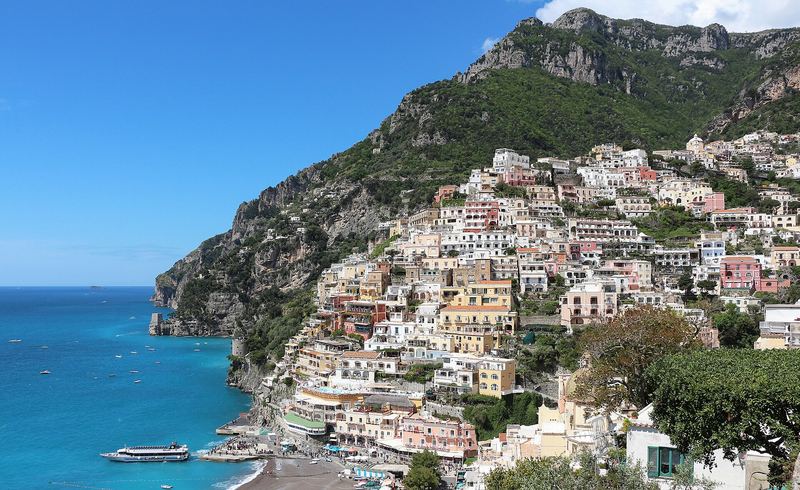
The Amalfi Coast is a single sweep of cliffs. Pastel houses stack up from the water, church domes glint in the sun and lemon terraces fall toward the sea. Positano is stylish and busy, Ravello calm and high, Amalfi central with its cathedral. There is less to do than on the Riviera, but every bend in the road frames another view.
The Riviera is more urban and social. The Amalfi Coast is more scenic and intimate.
Beaches and Boat Days
Neither coast is famous for sand. Nice's main beaches are pebbles, so bring water shoes or book a private beach club with loungers and mattresses. Juan-les-Pins, Antibes and parts of Cannes have sandier stretches. Swim off the rocks on the coastal path around Cap Ferrat, or take a short ferry from Cannes to the Lérins Islands for pine forests and clear coves.
Amalfi beaches are small and pebbly too, such as Positano's Spiaggia Grande and Fornillo, with beach clubs renting loungers and umbrellas by the day. The best swimming is from a boat. Hire a traditional gozzo to explore grottoes and coves, then cross to Capri for lunch and the Faraglioni rocks.
Boat days are the highlight on both. On the Riviera, charter a half day along the capes. On the Amalfi Coast, a private boat to Capri is the single best day of the trip. If boats are what you dream about, the Amalfi Coast has the edge.
Trains Versus a Cliff Road
The Riviera is far easier to get around. The regional TER train runs along the coast from Cannes through Antibes, Nice, Villefranche, Èze-sur-Mer and Monaco to Menton. Trains are frequent and cheap. You also avoid summer traffic and parking. Local buses climb to Èze village and Saint-Paul-de-Vence. You do not need a car.
The Amalfi Coast has one road, the Amalfi Drive, which is beautiful but narrow and congested in summer, with limits on non-resident cars on busy days. Driving yourselves is more stress than romance, so hire a private driver for transfers. In season, ferries link Positano, Amalfi, Salerno and Capri and are often faster than the road. Every town is vertical, so pack light for the stairs.
For couples who like to explore on their own schedule, the Riviera is the more relaxed choice. On Amalfi, plan to stay put more and let boats and drivers do the work.
Flights From the US
Nice Côte d'Azur Airport (NCE) is the Riviera's gateway, about 20 minutes from central Nice and 30 from Antibes. In summer it has nonstops from Newark, JFK, Washington Dulles and Boston. The rest of the year, connect through Paris or another European hub. The TGV from Paris takes about six hours, so most couples fly.
For the Amalfi Coast, most US travelers fly into Naples International Airport (NAP), usually connecting through Rome or another hub, or take the high-speed train from Rome to Naples or Salerno. From Naples, a private car to Positano or Amalfi takes about an hour and a half, depending on traffic.
In summer the Riviera is the simpler trip, since you can land a few miles from the beach on a nonstop. Outside summer the journeys are similar. Leave buffer time on the Amalfi side, because coast road traffic can double transfer times in peak season.
Grand Hotels and Value Stays
The Riviera works at almost any budget. Nice has a huge choice of hotels near the old town and the Promenade des Anglais. The three hotels we cover show the top end: Hôtel Belles Rives sits right on the water in Juan-les-Pins; Château de la Chèvre d'Or occupies stone buildings at the top of Èze, with terraces over the coast; and the Grand-Hôtel du Cap-Ferrat, A Four Seasons Hotel, has gardens running down to the sea.
The Amalfi Coast's famous hotels are among the most expensive in Italy in summer. We cover Le Sirenuse in Positano, Hotel Santa Caterina near Amalfi, Caruso, A Belmond Hotel in Ravello and Monastero Santa Rosa in Conca dei Marini. Smaller guesthouses help balance a budget.
On both coasts, a sunset drink at a grand hotel costs far less than dinner and gives you the same view. Treat all rates as approximate ranges that peak in July and August.
When to Go
June and September are the best months on the Riviera, with a warm sea, everything open and manageable crowds. July is lively and hot, while August is the busiest month by far, with jammed coast roads and peak prices. May and early October are pleasant for walking, though the water is cool for most Americans. May also brings the Cannes Film Festival and the Monaco Grand Prix, which fill hotels.
The Amalfi Coast's sweet spots are May, June and September, with early October often glorious. July and August bring heat, the busiest roads and the highest rates.
Winter splits them. On the Riviera, many beach clubs close from November to March, but Nice stays a working city, mild and often sunny. On the Amalfi Coast, most famous hotels close for winter and ferries cut back. For an off-season honeymoon, the Riviera is the more practical pick.
Food, Wine and Pairing Them
Niçoise cooking is its own cuisine, closer to Liguria than Paris. Try socca, a chickpea pancake from a wood oven, pissaladière and the real salade niçoise, then drink local rosé or wine from the tiny Bellet vineyards above Nice. A beach club lunch with a bottle of rosé is a Riviera classic. Amalfi cooking leans on the sea and the lemon: scialatielli with seafood, spaghetti alle vongole and delizia al limone, with Falanghina or Fiano and a limoncello to finish.
They pair naturally with different trips. The Riviera follows Paris or Provence, since the Luberon is about two and a half hours by car from Nice. The Amalfi Coast follows Rome or Tuscany. To do both coasts on one honeymoon, you will need a flight between Nice and Naples, often with a connection. With ten nights, four on each coast plus a city works well.