Cliffs Versus Coastline
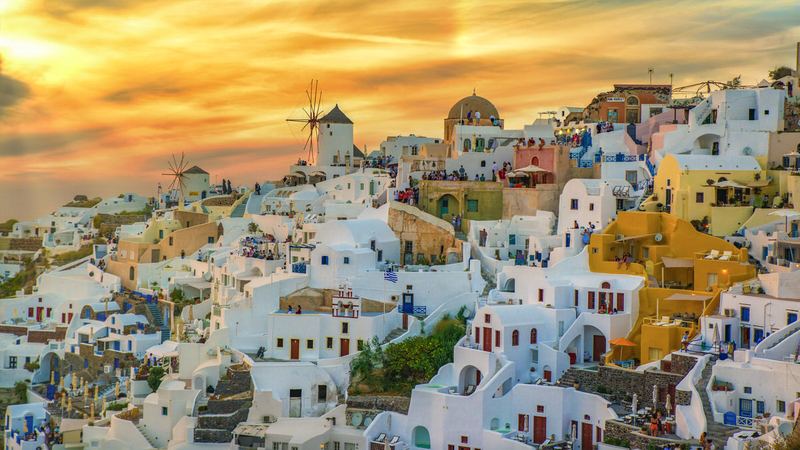
Santorini's landscape is vertical. The caldera rim is banded red, black and cream. White villages perch along the top like frosting. From almost any terrace on the western side you look across the water to Thirasia and the volcanic islets in the middle. It is dramatic at every hour, not just at sunset.
The beaches are the weak spot. The east coast towns of Kamari and Perissa have black sand that gets very hot. The famous Red Beach has had rockfalls that close or restrict access at times. Most swimming happens in your hotel pool or from a boat.
Naxos is horizontal by comparison. The west coast is a chain of soft sand beaches with shallow water, including Agios Prokopios, Agia Anna and Plaka. Behind them, the land rises into olive groves, marble villages and Mount Zas, the highest peak in the Cyclades. The view is less shocking but more varied. You can actually walk into the sea.
Where You Sleep Shapes the Trip
On Santorini, the caldera rim is where you want to be. Oia is the famous one. Katikies Santorini spills white cave suites down Oia's cliff, while Canaves Oia Epitome, just beyond the village, gives every suite and villa its own pool facing straight out to sea. In Imerovigli, the quieter high point of the rim, Grace Hotel from Auberge has only 23 rooms and a showpiece infinity pool. Fira is busier. Kamari and Perissa cost less but lose the caldera.
Naxos offers a different kind of comfort. Naxian Collection, on Stelida hill with Naxos Town across the water, has villas and suites with private or semi-private pools from roughly $650 a night in shoulder season. The beach villages south of town have boutique hotels with pools a few steps from the sand. Naxos Town itself has small hotels near the Kastro.
Expect stairs on Santorini, since caldera hotels are built into cliffs and porters carry bags the final stretch. On Naxos, you usually park outside the door.
What the Bill Looks Like
Santorini is one of the most expensive islands in Greece. Caldera suites with private pools sit at the very top of the market in July and August. The best ones for June through September can sell out six months or more ahead. Sunset dinners at the top hotel restaurants are priced accordingly. Shoulder months help: late May, June and late September bring noticeably better rates.
Naxos is one of the better values in the Cyclades. A comfortable boutique hotel near the beach often costs a fraction of a caldera-view room, which means a sea-view suite or a private pool is within reach on a budget that would buy a standard room on Santorini. Taverna meals are inexpensive. Car rentals cost less too.
All prices are approximate and move with the season. A useful rule: if you split a week between the two, put the splurge on Santorini for two or three nights and let Naxos stretch the rest of the budget.
Seasons and Crowds
Both islands run on a similar calendar. Late May through June and mid-September through early October are the sweet spots, with warm days, swimmable water and fewer people. Most caldera hotels on Santorini open from around April to late October or early November. Naxos Town stays open all year because people live there, though many beach hotels close in winter.
Crowds are the bigger difference. Santorini's lanes in Oia and Fira fill on summer days, especially when cruise ships are in port. The trick is to explore early and watch sunset from your terrace or from a boat. Naxos absorbs its visitors across a much larger island and rarely feels busy, except on the beaches near town in August.
Wind matters on both. The meltemi blows hardest in July and August. On Naxos it can make north-facing beaches choppy, though the west coast south of town is more sheltered. On Santorini it occasionally delays ferries and catamaran cruises.
Food, Wine and Evenings
Santorini's volcanic soil gives intensely flavored ingredients: cherry tomatoes for the famous fritters, creamy yellow fava, capers and white eggplant. The wine is the headline. Assyrtiko, dry with citrus and salt, grows on vines trained into low baskets against the wind. Vinsanto is the island's sweet wine from sun-dried grapes. Hotel restaurants such as Elements at Canaves Oia Epitome and Varoulko at Grace serve refined tasting menus with views.
Naxos feeds the rest of the Cyclades. Its potatoes are famous. Its cheeses are worth bringing home: graviera, xinomyzithra and arseniko. Order rosto, pork slow-cooked with wine and garlic. After dinner, sip kitron, the citron-leaf liqueur made in Halki.
Evenings follow the food. Santorini's are about a sunset table booked weeks ahead. Naxos evenings are about the walk to the Portara at dusk and a busy harbor-front dinner in town, or a quiet one in a village up in the hills.
Things to Do Together
Santorini packs a lot into a small space. Sail the caldera on a catamaran with swims near the warm springs and sunset at sea. Walk the cliff path from Fira through Firostefani and Imerovigli toward Oia, about six miles, ideally in the early morning. Visit Akrotiri, the Bronze Age town preserved under ash. Tour a winery, then have grilled fish at Ammoudi Bay below Oia.
Naxos asks for more time and gives back more room. Walk out to the Portara, the marble doorway of an unfinished temple to Apollo, before sunset. Drive the interior through Halki, Filoti and Apiranthos. Hike Mount Zas, about two hours to the top. See the giant unfinished kouros statues near Melanes and Apollonas. Take a boat to Koufonisia for turquoise coves.
Couples who like a full program will love Santorini's density. Couples who like to wander will find Naxos more rewarding day after day.
How to Pair Them
This is a natural combination. Fast ferries connect Naxos and Santorini several times a day in summer. The trip is short enough to do mid-morning without losing the day. Both islands also link to Paros and Mykonos.
A strong plan for a week is three nights on Santorini for the caldera, sunset and wine, then four on Naxos to swim and slow down. With ten nights, add Paros between them. Starting on Santorini and ending on Naxos tends to work best: you get the spectacle while you are fresh and finish rested on a beach.
Leave room for weather. Summer winds can delay or cancel boats, so avoid taking the last ferry or flight on the same day as your international departure from Athens.