Two Kinds of Beach Town
Seminyak is about pleasure close to home. Couples wake in a villa with a pool and an outdoor bath, spend the afternoon on a daybed, walk to the beach for sunset and then choose from dozens of restaurants. The beach faces west, so sunset is a daily event. The trade-off is traffic. Seminyak is busy and getting busier, so it works best when you stay close to your villa and the sand.
Phuket is about choice and day trips. Thailand's largest island has quiet corners and lively ones. The northwest coast around Nai Thon, Nai Yang and Cherngtalay is calm and close to the airport. Hillsides above Kamala and Surin are secluded. Patong is the nightlife hub, best visited for an evening rather than stayed in.
Seminyak is a few nights of easy beach living. Phuket can carry a whole honeymoon, with boat trips and island hops.
Opposite Seasons
Their best months barely overlap, which often makes the decision for you.
Seminyak's dry season runs from about April to October, with sunny days, lower humidity and the beach at its best. July, August and the Christmas and New Year holidays are busiest. May, June and September are the sweet spots. The rainy season, from about November to March, brings heavy afternoon or evening downpours, occasional road flooding and rubbish washing up on west coast beaches. Nyepi, Bali's Day of Silence in March or April, shuts the whole island for 24 hours, including the airport.
Phuket's best months run roughly November to April. December through February is peak, with the most reliable weather and highest rates. March and April are hotter but still dry and often slightly better value. The southwest monsoon arrives around May and lasts until about October, bringing showers, bigger waves and red flags.
A summer honeymoon favors Seminyak. A winter one favors Phuket.
Where You Will Stay
Seminyak's beachfront hotels are the classic choice. The Oberoi Beach Resort, Bali has thatched villas in gardens above the sand. The Legian Seminyak offers spacious suites facing the ocean. Alila Seminyak and W Bali Seminyak are more contemporary, with big pools and beach bars. Private villas in the lanes behind the beach, or in Petitenget, Umalas and Kerobokan, are often better value. Check that your pool is fully private. For quieter nights, look north toward Petitenget or Batu Belig.
Phuket's strongest stays are on its quieter coasts. Trisara is a classic hillside retreat with west-facing pool villas over its own bay and an acclaimed restaurant, PRU. Keemala sits in the rainforest above Kamala, with 38 villas shaped like clay cottages, tents, tree houses and bird's nests, each with a private pool. Amanpuri, Rosewood Phuket and the Laguna resorts round out the luxury scene.
In both, location shapes the experience more than the hotel brand.
Food and Evenings
Seminyak is Bali's dining capital. Within a few blocks you can eat refined Indonesian, Mediterranean, Japanese or modern Australian cooking, often for well below US prices. Try babi guling and bebek betutu, or a cheap plate of nasi campur at a warung. Sunset drinks are a ritual, at a beach club such as Potato Head or on a rooftop. Book special restaurants a few days ahead in high season. Imported wine is expensive. Avoid homemade arak entirely.
Phuket has its own cuisine, shaped by Chinese, Malay and Thai traditions. Try moo hong, a slow-braised pork belly, along with spicy southern curries and Hokkien-style noodles in Old Phuket Town. PRU at Trisara has long been recognized by the Michelin Guide. Several other island restaurants appear in it too. For a casual night, pick your fish at a beachfront seafood restaurant at sunset.
For nightly variety, Seminyak wins. For distinctive local cooking, Phuket is a treat.
Days Out Together
From Seminyak, the best days are short. Watch a ceremony at Pura Petitenget, a seaside temple that has stood for centuries, dressed in a sarong and sash. Book a couples spa treatment with a flower bath. Shop along Jalan Laksmana and in Kerobokan. Drive about an hour north to Tanah Lot, a temple on a rock in the sea, at sunset. Hire a driver for a day of rice terraces and temples.
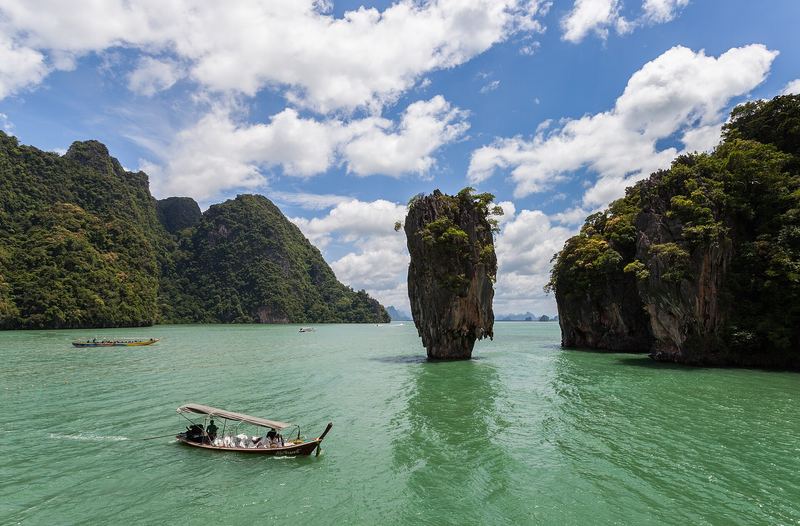
Phuket's essential outing is Phang Nga Bay. Charter a private long-tail or speedboat early to kayak into hidden sea caves and drift past the limestone pinnacle known as James Bond Island. Wander Old Phuket Town's Sino-Portuguese shophouses and its Sunday walking street market. Watch sunset from Promthep Cape. Take a day trip to the Phi Phi Islands, or to the Similan Islands between roughly mid-October and mid-May for clear-water snorkeling.
Phuket offers more full-day adventures. Seminyak offers more lazy afternoons.
Getting There and Around
Neither has nonstop flights from the US, so plan on 20 hours or more.
For Seminyak, fly into Bali's Ngurah Rai International Airport (DPS), usually via Singapore, Tokyo, Seoul, Taipei, Hong Kong or a Middle East hub. The airport is only about 10 miles away, but the drive can take 30 minutes to over an hour in traffic. Walking is often fastest for short trips. Grab and Gojek work for longer ones.
For Phuket, connect through Asia or the Middle East, either directly into Phuket International Airport (HKT) or via Bangkok on a short domestic flight. Northwest-coast resorts are just 15 to 20 minutes from the airport, while Kamala takes about 40 to 45. Public transport is limited, so use hotel transfers, Grab or a private driver.
In both places, skip the scooter unless you are experienced. Phuket's quick airport transfers are a real advantage after a long flight.
Costs and Practical Tips
Both are good value. All figures are approximate and rise in peak season.
In Seminyak, a one-bedroom villa with a private pool runs about $150 to $400 a night, while beachfront resorts often cost $400 to $900 or more. Drivers by the day cost far less than at home. In Phuket, Trisara and Keemala are the splurge picks, while Thailand's upscale pool-villa resorts generally run roughly $300 to $700 a night in high season.
Swimming needs care in both. Seminyak's beach has strong currents and rips, so swim between the red and yellow flags. Phuket's west coast can be dangerous from May to October, so respect beach flags. Dengue is present in both, so use repellent at dusk. If you're pregnant or hoping to be soon, check CDC travel health notices.
At temples, both of you should cover shoulders and knees. Drug penalties are severe in both countries.