Landscapes and Beaches
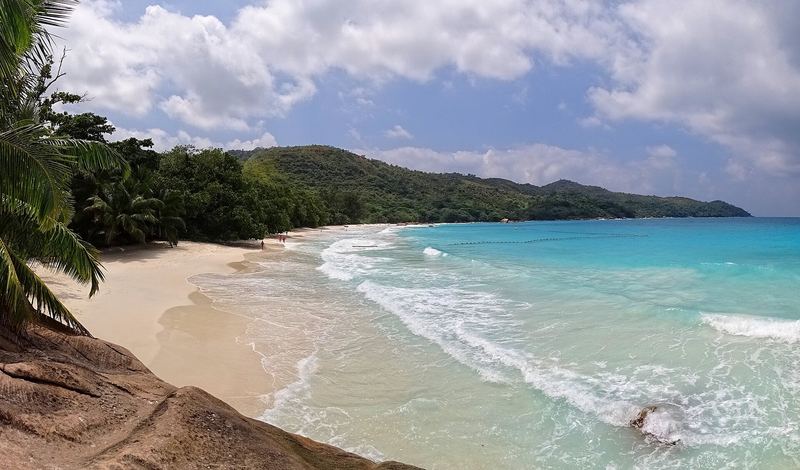
The Seychelles looks like nowhere else. Smooth granite boulders in shades of pink and gray frame white sand and clear water, with jungle-covered mountains behind. Anse Source d'Argent on La Digue and Anse Lazio on Praslin routinely top international beach rankings. Praslin's Vallée de Mai, a UNESCO World Heritage forest, is home to the coco de mer palm.
Mauritius has a gentler coastline and a more dramatic interior. The reef holds the water in pale lagoons that look lit from below. Le Morne, a UNESCO-listed basalt mountain on the southwest tip, rises over one of the island's best beaches. Inland, Black River Gorges has rainforest trails and Chamarel has the Seven Coloured Earths and a waterfall.
For beaches alone, the Seychelles is more striking. For a mix of beach and landscape on one island, Mauritius is easier.
Swimming and Sea Conditions
Mauritius has the advantage for easy swimming. Its reef does the work, so the lagoon in front of most resorts stays waist to chest deep for a long way out. That makes kayaks, paddleboards and lazy snorkeling simple even when the open ocean is rough. The wild south coast around Gris Gris has no reef in places and is for looking at, not swimming.
The Seychelles depends more on the wind. From about May to September, the southeast trades bring choppy seas and strong currents to southeast-facing coasts. Grand Anse on La Digue and Anse Intendance on Mahé are beautiful but often unsafe for swimming then. Because beaches face in all directions, you can usually find calm water somewhere. The transition months are excellent for snorkeling.
In both, pack water shoes for coral rubble and sea urchins. Swim where locals swim and heed warning flags.
Best Months to Go
The Seychelles is warm all year and sits outside the main cyclone belt. The transition months, April to May and October to November, are widely considered best, with calm seas and excellent visibility. May to September is drier but breezier. December to March is hotter and more humid, with heavier showers.
Mauritius has a hot, humid summer from November to April, with tropical downpours and a cyclone season that peaks between late December and March. Direct hits are not frequent, but a nearby storm can bring several days of wind and rain. Dengue flares in some years in the wet months, so if you're pregnant or hoping to be soon, check CDC travel health notices. Winter, from May to October, is drier and cooler. The sweet spots are April to early June and September to early December.
The calendars overlap nicely. April, May, October and November suit both well. Christmas and New Year are peak-priced in both.
Resorts and Private Islands
The Seychelles leans toward small, villa-only resorts. Raffles Seychelles on Praslin has pool villas above Anse Takamaka and makes a good island-hopping base. Four Seasons Resort Seychelles covers Mahé. Hilton Seychelles Labriz sits on Silhouette Island. For private islands, North Island has just 11 large villas. Six Senses Zil Pasyon on Félicité sits near La Digue. Denis Private Island and Four Seasons Desroches add remote options.
Mauritius has larger, polished beach resorts with a long tradition of half-board stays. On the Le Morne peninsula you can choose LUX* Le Morne, The St. Regis Le Morne and Paradis Beachcomber. Constance Prince Maurice sits on the east coast near Belle Mare. Heritage Le Telfair is in Bel Ombre on the south coast. Grand Baie in the north is the sociable side, with restaurants and calm water.
If you want a private island, the Seychelles is the clear choice. Mauritius focuses on beach resorts with easy access to the rest of the island.
What It Costs
Mauritius is the better value. All figures are approximate.
In Mauritius, comfortable four-star beach hotels often run $250 to $450 a night for two with breakfast or half board. Five-star resorts typically start around $600 and can pass $1,500 in peak weeks. Guesthouses in places like Flic en Flac can cost well under $150. A dinner for two at a local restaurant might be $40 to $80, catamaran trips run about $60 to $120 per person and a rental car about $30 to $50 a day.
In the Seychelles, luxury resorts on Praslin and Mahé range from several hundred to well over a thousand dollars a night. Private islands typically start well into four figures and can reach several thousand. Helicopter transfers add a significant sum.
The Seychelles can be stretched with a mid-range hotel for part of the trip, ferries instead of flights and meals at Creole takeaways. Mauritius is simply cheaper day to day.
Getting There and Around
Neither has nonstop flights from the US. Both take a full travel day.
For the Seychelles, most couples connect through Dubai, Doha or Addis Ababa into Seychelles International Airport (SEZ) on Mahé, with 20 or more hours from the East Coast. From Mahé, ferries or short flights reach Praslin, a short ferry links Praslin with La Digue and helicopters or small planes serve the private islands.
For Mauritius, Emirates through Dubai is the most popular routing. Air France and Air Mauritius fly from Paris, British Airways from London and Turkish Airlines from Istanbul. Door to door is roughly 20 to 26 hours into Sir Seewoosagur Ramgoolam Airport (MRU). Resort transfers are by road, from 30 minutes to about 90.
Both drive on the left. In Mauritius a rental car gives the most freedom, while taxis have no meters, so agree the fare first. In the Seychelles, Mahé and Praslin roads are narrow and winding. La Digue is best by bicycle.
Culture, Food and Safety
Both share Creole roots with French and British history, so a bonzour works in each. The Seychelles blends African, French, British, Indian and Chinese influences. Life is relaxed, though beachwear should stay on the beach and topless sunbathing is generally not acceptable on public beaches. Don't take shells or coco de mer nuts without permits.
Mauritius has a larger, more varied population. Roughly half is Hindu, with large Christian and Muslim communities, so festivals fill the calendar. Remove shoes and cover shoulders and knees at temples and mosques. The food is a highlight: dholl puri from street stalls, Creole curries and Chinese noodles.
The State Department rates Mauritius Level 2 for crime, mostly theft from beaches, cars and ATMs. Use the hotel safe, keep bags out of sight in rental cars and take a taxi rather than walking unlit roads at night. In the Seychelles, ordinary precautions apply.