City Polish Against Village Calm
Singapore packs its contrasts close together. Shophouse lanes in Kampong Glam and Joo Chiat sit a short ride from the glass towers of Marina Bay. You can walk a treetop trail in the morning, swim in a rooftop pool in the afternoon and drink a Singapore Sling in the bar where it was invented by evening. Everything works, which leaves your energy for the fun parts.
Ubud runs at a different speed. Mornings start with mist over the Ayung River. Afternoons might be a walk along the Campuhan Ridge, where two rivers meet below a long grassy spine, or a visit to the Neka Art Museum. Evenings are long dinners with frogs and cicadas for company.
Neither is better. Singapore is stimulation with comfort built in. Ubud is quiet with culture woven through it. Couples who get restless by day three of a resort stay often love Singapore. Couples who want to unplug tend to fall for Ubud.
The Long Flight Question
Singapore has a real advantage here. Singapore Airlines flies nonstop from Newark, JFK, Los Angeles, San Francisco and Seattle. United flies from San Francisco. Expect roughly 16 to 19 hours in the air, the longest from the East Coast. Changi Airport is a pleasure to land in. The MRT reaches the city in under an hour. One-stop routings through Tokyo, Seoul, Taipei, Hong Kong or Doha are often cheaper.
Ubud has no nonstop option from the US. You fly into Bali's Ngurah Rai International Airport (DPS), usually through Singapore or another Asian hub, with total travel often over 20 hours. The drive up to Ubud then takes 1 to 1.5 hours and can stretch longer in traffic. Book a private transfer through your resort.
This is why the two pair so well. Fly nonstop to Singapore, recover for a few nights and take the short flight to Bali once you are rested. About two and a half hours separates them.
Weather Through the Year
Singapore is hot and humid all year, with daytime highs around 88 to 91°F. The seasons are about rain. February through April tends to be the driest and sunniest stretch. November to January brings the wettest weeks, often as long afternoon downpours. June through September is drier but can bring haze from fires in neighboring Indonesia. Rain rarely ruins a day, because a covered walkway or a mall is always close.
Ubud is warm too, with highs in the mid-80s and nights cooler than the coast. Its drier months run roughly April to October, with August usually the driest. July, August and the late-December holidays are the busiest and priciest. May, June and September are a lovely balance. November to March brings heavy afternoon rain, though the rice fields look their greenest and rates often drop.
For the two together, April through June and September are the sweet spot. Singapore works in any month, so let Ubud's season set your dates.
Hotels Versus Villas
Singapore's stays are city hotels. Very good ones, too. Marina Bay is where to go for the skyline, including the rooftop infinity pool at Marina Bay Sands. The colonial Raffles Hotel is the classic splurge. Sentosa, a resort island off the south coast, has spa hotels and beaches for a slower pace. Comfortable four-star rooms often run $200 to $350 a night, while landmark luxury hotels commonly sit between $500 and $1,200 or more (approximate).
Ubud is a resort destination, with many of the best lining the Ayung River gorge west of town. Four Seasons Resort Bali at Sayan is famous for its arrival over a suspension bridge onto a rooftop lotus pond. Mandapa, a Ritz-Carlton Reserve, has walled pool villas on the riverbank and dinners in bamboo pods. Capella Ubud, designed by Bill Bensley, has themed luxury tents with saltwater pools on a jungle ridge. The big river resorts run from about $700 to well over $1,500 a night (approximate).
In Singapore you sleep well. In Ubud the villa is half the honeymoon.
Where the Money Goes
Singapore is expensive by Asian standards, mostly because of hotels and drinks. Alcohol is heavily taxed. A cocktail at a well-known bar often costs $20 to $30 (approximate). Food can be the bargain. Hawker dishes run roughly $4 to $8. Several stalls have earned Michelin recognition. A good restaurant dinner for two with wine can reach $150 to $300 (approximate). Trains cost under $2 a ride.
Ubud flips the equation. The famous resorts are costly, but everything around them is good value. Boutique villas in the rice fields can cost about $150 to $400 a night (approximate, higher in July and August). Warung meals, massages and a driver for the whole day cost far less than a single Singapore cocktail session.
The smart Singapore plan is one great hotel and mostly hawker meals. The smart Ubud plan is the best villa you can afford, since you will spend so much time in it.
Eating Your Way Through
Food may be the strongest reason to include Singapore. Hawker centres serve Chinese, Malay, Indian and Peranakan dishes side by side. Try chili crab under fluorescent lights with a cold Tiger beer, a bowl of laksa in Joo Chiat and an evening at Maxwell Food Centre in Chinatown. Dempsey Hill has leafy restaurants in former army barracks. There is also a deep bench of serious restaurants worth booking months ahead.
Ubud is one of Bali's best places to eat. Try babi guling, the spit-roasted pork. Bebek betutu is duck slow-cooked in spice paste. Nasi campur is a plate of rice with small portions of many dishes and a good introduction. Resort dining is a highlight: a Balinese chef's table at Sokasi at Four Seasons Sayan, a fire-cooked menu at Capella's Api Jiwa or a private dinner in a rice field.
If one of you is a serious eater, Singapore earns its nights for that alone.
Days Out for Two
In Singapore, start with the Botanic Gardens in the cool morning, then return to the Supertree Grove at dusk for the free light show. Walk the Southern Ridges to Mount Faber and ride the cable car to Sentosa. For a wilder half day, take a bumboat from Changi Point to Pulau Ubin and cycle past mangroves and kampong houses. Spend an evening on Chinatown's cocktail bars or Kampong Glam's lanes.
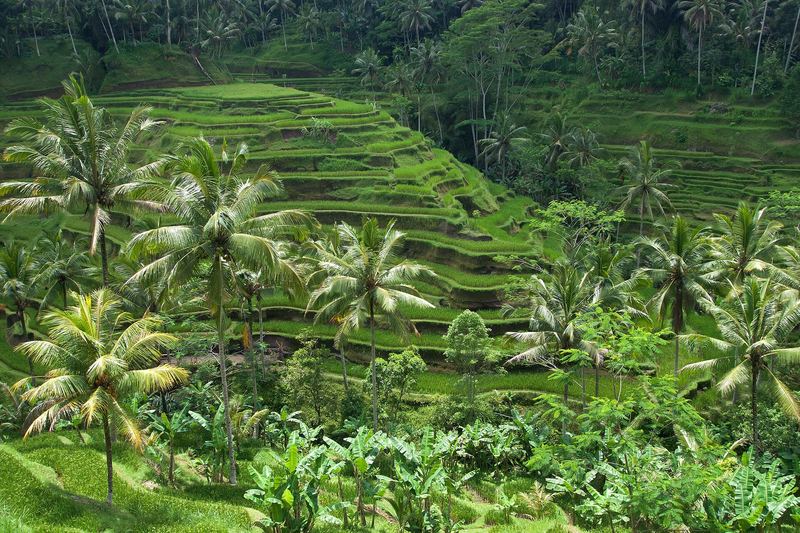
In Ubud, watch sunrise at the Tegallalang rice terraces before the crowds arrive. Take part in a water purification ritual at Tirta Empul with a priest or knowledgeable guide. Raft the Ayung River, then book a couples' massage. Take a Balinese cooking class and grind your own spice paste. See a Legong or Kecak performance in a temple courtyard. Keep your distance from the macaques at the Sacred Monkey Forest, which grab sunglasses and can bite.
Singapore keeps you moving. Ubud invites you to fill a day slowly.
Practical Notes for Each
Singapore is famous for its rules. Littering, jaywalking and eating on the MRT can bring fines. Drug laws are extremely strict, including the death penalty for trafficking. Return your tray at hawker centres. A packet of tissues on a table means the seat is taken. Cover shoulders and knees at temples and mosques. Tipping is not expected because most bills include a service charge.
In Ubud, both of you will need a sarong and sash at temples. Shoulders and knees should be covered. Hire a driver rather than a scooter unless you are experienced, since roads are narrow and busy. Ask your resort about local ceremonies, which visitors can often watch respectfully.
Dengue circulates in both places, so use repellent at dawn and dusk, especially in gardens and around rice fields. If you're pregnant or hoping to be soon, check CDC travel health notices for Singapore and Indonesia before you go.