Culture Capital or Country Valley
Ubud's days fill themselves. Walk the Campuhan Ridge where two rivers meet, then visit the Puri Lukisan, Neka or Agung Rai art museums. Watch Legong or Kecak dancers in a palace courtyard. Join a water purification ritual at Tirta Empul with a priest or guide. Raft the Ayung River. It is a town with a lot going on. That is both its charm and its weakness, because traffic in the center can be heavy.
Sidemen's days are emptier on purpose. There are no big shopping streets, no beach clubs and few tour buses. Mornings are for a guided walk along irrigation channels between paddies, with a guide explaining the subak water system. Afternoons are for a massage or a nap while rain moves through the valley. Offerings are made at family shrines each morning and songket weaving is still a living craft. It feels like a window into daily Balinese life rather than a destination built for visitors.
The Views From Your Villa
Ubud's resort views are about the jungle. Villas cling to the walls of river gorges and rooftops float at canopy level. At Four Seasons Sayan you arrive over a suspension bridge onto a lotus pond with the Ayung valley below. Misty mornings over the river are the classic Ubud scene.
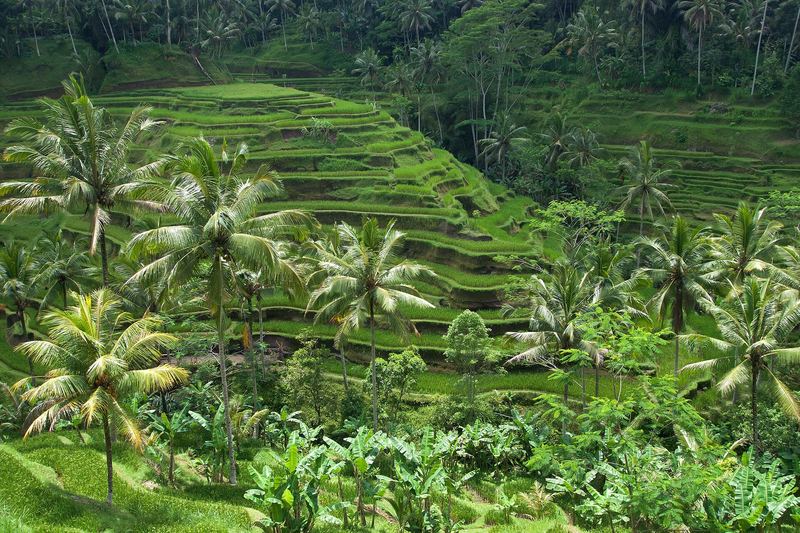
Sidemen's views are about the mountain. Most villas sit on the valley slopes, so the view from bed is green terraces and the cone of Agung, at a little over 3,000 meters. In the dry season, clear mornings show the whole volcano before clouds gather around midday. The rice cycle keeps changing the picture too, from flooded fields reflecting the sky to bright green shoots to golden paddies before harvest.
Ubud has famous rice terraces as well, at Tegallalang, but they draw crowds by mid-morning. Sidemen's terraces are all around you, with far fewer people on the paths.
Where You Would Stay and What It Costs
Ubud has the bigger names. Four Seasons Resort Bali at Sayan terraces down the Ayung valley with many villas featuring plunge pools. Mandapa, a Ritz-Carlton Reserve, has walled pool villas on the riverbank and a working rice field. Capella Ubud, designed by Bill Bensley, offers luxury tents with saltwater pools on a ridge in Keliki. The big Ayung River resorts run from about $700 to well over $1,500 a night. Boutique villas in the rice fields cost about $150 to $400.
Sidemen's lodging is mostly small villa resorts and family-run guesthouses spread along the valley road. Higher slopes look across the terraces directly at Agung. Rooms near the river put the paddies right outside. Look for an infinity pool facing the volcano and an in-house restaurant. Comfortable villas run very roughly $70 to $250 a night, with few big-brand options.
All prices are approximate and climb in July and August.
Eating Well in Each
Ubud is one of Bali's best places to eat. Try babi guling, the spit-roasted pork, or bebek betutu, duck slow-cooked in spice paste. Healthy cafes and plant-based restaurants reflect the wellness crowd. Resort dining is a highlight in its own right, from a Balinese feast at Sokasi in Four Seasons Sayan to the fire-cooked tasting menu at Capella's Api Jiwa. Many resorts set up private dinners in the rice fields or by the river.
In Sidemen, most meals happen at your villa. Many cook excellent Balinese food with vegetables from local gardens. Order babi guling or bebek betutu a day ahead. A few warungs on the main road serve nasi campur at local prices. Coffee and cacao grow in the hills. Salak, the snake fruit, is everywhere in Karangasem. Nightlife does not exist and few places stock wine, so bring a bottle if you want one with dinner.
Getting There and the Drive Between
There are no nonstop flights from the US to Indonesia. Most couples fly into Ngurah Rai International Airport (DPS) through Singapore, Tokyo, Seoul, Taipei, Hong Kong or a Gulf hub, with total travel time often over 20 hours.
Ubud is about 1 to 1.5 hours from the airport, though traffic can stretch that considerably. Sidemen is about two hours. The drive from Ubud to Sidemen takes roughly one to one and a half hours, so moving between them costs a morning rather than a day.
In Ubud, resort shuttles, private drivers and ride-hailing apps cover most needs. In Sidemen, public transport is minimal and ride-hailing cars may not want to come out to the valley, so arrange transfers through your villa. A car with a driver is the easy way to reach Besakih or Tirta Gangga. Scooters are risky in both places unless you are experienced, since roads are narrow and winding.
Weather, Seasons and the Volcano
The two share a calendar. The drier months run roughly April to October in Ubud, with August usually driest. Sidemen's driest stretch is about April to September, when clear mornings give the best Agung views. May, June and September are a sweet spot in both, with good weather and fewer crowds than July and August.
The wet season, about November to March, brings heavy afternoon downpours followed by clear spells. January and February are the wettest. The landscapes are at their greenest, rates often drop and both places feel atmospheric if you like listening to rain from a covered terrace.
Sidemen comes with one extra note. Agung is an active volcano that erupted between 2017 and 2019. The valley sits outside the usual exclusion zones and daily life carries on normally, but check the official alert level before you travel and buy insurance that covers disruption. Valley evenings are also cooler than Ubud, so bring a layer.
Splitting the Inland Leg
Our Sidemen guide suggests two to four nights as the calm middle of a Bali trip. That fits well with Ubud. A ten to twelve night honeymoon might run three nights in Ubud for culture and food, two or three in Sidemen for rest, then the rest on the coast. From Sidemen you can continue east toward Amed or Padang Bai, or head south to Uluwatu to finish with sunsets.
If you only have a week and want a single inland stop, choose Ubud for its resorts and range. Choose Sidemen only if quiet is the whole point and a famous resort brand matters little to you. Either way, mention your honeymoon when you book, since smaller villas in particular often add flowers or a special dinner.